The Evidence, Honestly: Proven, Promising, and Free

"Vagus nerve stimulation" covers three very different things that get blurred together in marketing. One is real, established medicine. One is a promising but thinly studied consumer category. One is free and works. Keeping them separate is the single most useful thing you can learn about this topic, and it is the whole escape route out of the Vagus Gadget Trap: the mistake of assuming a $400 consumer device inherits the evidence of real clinical stimulation. It does not.
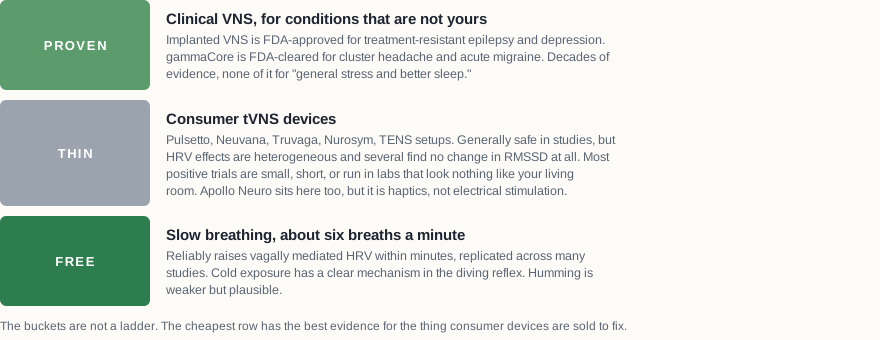
Bucket 1: Proven (Real Medicine, Specific Conditions)
Clinical vagus nerve stimulation has decades of evidence, but for specific diagnoses, not general stress.
- Implanted VNS: A surgically placed device wired to the vagus nerve. FDA-approved for treatment-resistant epilepsy and for treatment-resistant depression. This is serious, prescribed medicine with real surgery involved.
- gammaCore (non-invasive): A handheld device held to the neck. FDA-cleared for cluster headache and for acute treatment of migraine, and later for paroxysmal hemicrania and hemicrania continua. It is available through prescription and clinics.
Notice what these clearances are for: epilepsy, depression, and headache. None of them is "general stress and better sleep." That distinction matters when a consumer gadget borrows the phrase "vagus nerve stimulation" and hopes you assume the same evidence applies. It does not.
Bucket 2: Promising but Thin (Consumer Wellness Devices)
This is where Pulsetto, Neuvana, Truvaga, Nurosym, and TENS-based setups live. They use transcutaneous (through-the-skin) stimulation of the vagus nerve at the neck or ear, called tVNS or taVNS. The category is real and actively researched, but the evidence for the specific consumer claims of "lower stress" and "better sleep" is limited and mixed.
What the research actually shows:
- Transcutaneous auricular VNS is generally safe in studies, with mostly mild, temporary side effects like local tingling, headache, or fatigue. A large safety review flagged that many studies do not even report adverse events carefully, so "safe" comes with an asterisk about study quality.
- Effects on HRV are heterogeneous. Some studies find changes in certain HRV measures; others find no effect on RMSSD, the metric most tied to vagal activity. Reviewers describe the findings as inconsistent.
- Most positive studies are small, short, or run under lab conditions that do not match a consumer using a gadget at home for a few minutes.
Truvaga deserves a note: it uses the same stimulation parameters as its prescription sibling gammaCore, so it has a stronger technical pedigree than most. But being built like a cleared medical device is not the same as being cleared for stress relief, which it is not.
And Apollo Neuro, often lumped in here, is not an electrical vagus stimulator at all. It uses gentle vibration (haptics) on the skin. It happens to have some of the better published evidence in the consumer wellness-wearable space, including small randomized trials and reports of modest HRV improvement, but it works through touch, not by stimulating the vagus nerve with current. Do not confuse the two.
Bucket 3: Free and Reliable (Do This First)
Slow breathing at around six breaths per minute with a long exhale reliably raises vagally mediated HRV within minutes, across many studies. It is the most repeatable, best-supported, cheapest intervention on this entire page. Cold exposure has a clear physiological mechanism through the diving reflex. Humming and chanting have weaker but plausible support.
The uncomfortable takeaway for the gadget industry: the free methods have better evidence than the devices. Full instructions are on the free methods page.
How to Read Any Device's "Clinically Proven" Claim
Ask four questions before you believe it:
1. Proven for which outcome? Stress relief is a different claim than seizure reduction.
2. On which device? Studies on one stimulator do not transfer to another brand.
3. How many people, for how long? A 20-person pilot is a hint, not proof.
4. Compared to what? If there was no sham or placebo group, the result may just be expectation.
The Bottom Line
Clinical VNS is real medicine for specific conditions. Consumer stress devices are worth a curious experiment if you go in clear-eyed, but they are not proven treatments and results vary a lot person to person. Free breathing is the thing with the best evidence and zero cost, so it should be your foundation no matter what else you try. If you still want to shop, the device guide rates each option on exactly this honesty scale.